
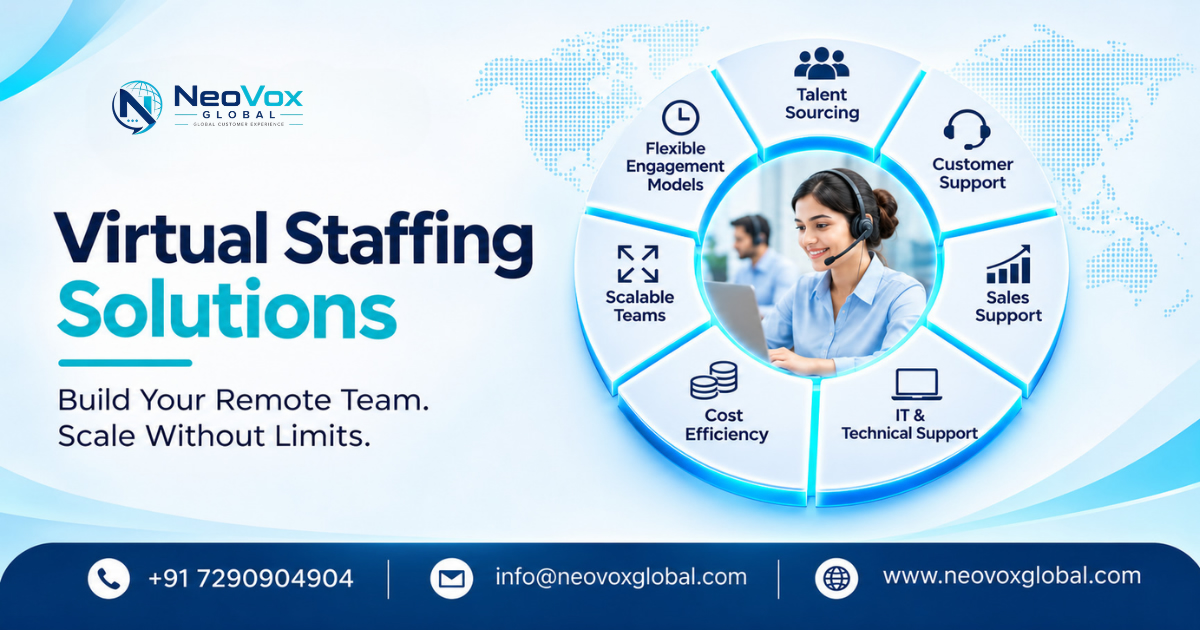
Businesses often need additional support to manage customer communication, administrative work, sales activities, and daily operations. However, hiring full-time employees for every task can increase operational expenses and create challenges when business requirements change. For companies looking to remain flexible while maintaining productivity, virtual staffing has become a practical option.
Virtual staffing solutions allow businesses to work with professionals who perform assigned tasks remotely, helping teams manage workloads without necessarily expanding their traditional office workforce. From customer support and lead generation to administrative assistance, virtual professionals can support several important business functions.
Businesses in Noida, including startups, growing companies, service providers, and established enterprises, can explore virtual staffing as a way to improve operational flexibility. Understanding how this model works, which services can be outsourced, and what to consider before hiring can help businesses make better staffing decisions.
What Are Virtual Staffing Solutions?
Virtual staffing solutions involve hiring remote professionals to perform specific business tasks or responsibilities without requiring them to work physically from the company’s office. These professionals may work full-time, part-time, on a project basis, or according to an agreed schedule.
Unlike traditional recruitment, where employees are hired to work at a physical location, virtual staffing enables businesses to access talent remotely. The business can assign responsibilities, establish workflows, communicate through digital tools, and monitor performance based on defined objectives.
Virtual staffing can cover a wide range of functions, including:
- Customer service and inbound call handling
- Outbound calling and follow-ups
- Chat and email support
- Lead generation and prospect outreach
- Administrative assistance
- Data entry and documentation
- Scheduling and coordination
- Business support activities
The exact responsibilities depend on the company’s requirements, the skills needed, and the staffing arrangement.
For businesses that need operational support without creating additional office-based positions, virtual staffing provides another way to organize their workforce.
Why Businesses in Noida Are Exploring Virtual Staffing
Noida has a diverse business ecosystem that includes IT companies, startups, consulting businesses, e-commerce operations, service providers, and corporate offices. As businesses grow, their operational requirements often become more demanding.
A company may need additional employees to respond to customer enquiries, follow up with sales leads, manage appointments, process routine administrative tasks, or provide support outside regular working hours.
Hiring for every requirement internally may not always be the most practical approach.
Virtual staffing solutions can help businesses in Noida address these requirements by providing access to remote professionals who can work according to the company’s operational needs.
Some common reasons businesses consider this model include:
Managing increasing workloads: When existing employees have too many responsibilities, remote staff can take over specific tasks and help teams manage their workload more effectively.
Reducing recruitment pressure: Businesses may avoid handling every recruitment, onboarding, and staffing activity internally when they work with an outsourcing partner.
Supporting business growth: Companies can explore additional staffing resources when they expand their services, customer base, or operational activities.
Improving flexibility: Staffing requirements can change depending on workload, business priorities, and customer demand. Virtual staffing allows businesses to explore more flexible arrangements.
The objective is not simply to replace existing employees. It is to create a workforce structure where different responsibilities are managed efficiently.
Types of Virtual Staffing Services Businesses Can Outsource
Virtual staffing is not limited to administrative tasks. Businesses can outsource several operational functions depending on their needs and available resources.
Customer Support and Inbound Call Services
Customer support teams manage enquiries, provide information, assist customers with service-related questions, and help direct requests to the appropriate department.
Inbound call support can be useful for businesses that receive regular customer calls but may not have sufficient internal resources to handle them consistently.
Virtual customer support professionals can assist with:
- Answering customer enquiries
- Handling incoming calls
- Providing product or service information
- Managing customer requests
- Recording customer interactions
- Escalating complex enquiries
A structured support process helps businesses maintain communication with customers while allowing internal teams to focus on their primary responsibilities.
Outbound Calling and Follow-Up Support
Outbound calling involves contacting existing customers, prospects, leads, or other relevant audiences for business-related communication.
Companies may need outbound support for appointment confirmations, lead follow-ups, customer feedback, enquiry management, or other communication activities.
Virtual professionals can work with predefined scripts, call guidelines, contact lists, and reporting procedures to support these activities.
Businesses should establish clear communication objectives and ensure that outreach practices comply with applicable regulations and customer preferences.
Chat and Email Support
Many customers prefer communicating through email or live chat instead of making phone calls. Managing these channels can become challenging when enquiries arrive throughout the day.
Virtual staffing can help businesses manage written communication by assisting with:
- Responding to customer emails
- Handling website chat enquiries
- Managing routine questions
- Forwarding complex requests
- Organising communication records
- Following up on unresolved enquiries
Consistent communication helps businesses provide customers with a more organised support experience.
Lead Generation and Sales Support
Businesses need a consistent process to identify prospects, organise enquiries, and follow up with potential customers.
Virtual staffing professionals can assist with lead generation activities, prospect research, initial outreach, data organisation, and appointment coordination.
These responsibilities can help sales teams spend more time on qualified prospects and meaningful sales conversations rather than routine administrative work.
Administrative and Virtual Assistant Services
Administrative responsibilities can consume a significant amount of time for business owners, managers, and operational teams.
Virtual administrative professionals may assist with:
- Data entry and record management
- Calendar and appointment scheduling
- Document preparation
- Email organisation
- Report preparation
- Routine coordination
- General administrative support
These services can be particularly useful for small businesses and startups that need administrative assistance but may not require a dedicated in-office employee for every task.
Key Benefits of Virtual Staffing Solutions
Virtual staffing solutions can offer several operational advantages when implemented with clear expectations and suitable processes.
Greater Operational Flexibility
Businesses can choose staffing arrangements based on their workload and requirements. This flexibility can be useful when responsibilities change, new projects begin, or additional support is needed.
Instead of creating a fixed workforce structure for every activity, businesses can assess which responsibilities require permanent internal employees and which can be managed remotely.
Better Use of Internal Resources
When routine tasks are handled by dedicated support professionals, internal employees can focus on activities that require their specialised knowledge, decision-making abilities, or direct involvement.
For example, a sales manager may spend less time organising lead records and more time conducting sales meetings. A business owner may delegate appointment scheduling and routine communication while focusing on business development.
Potentially Lower Operational Overheads
Traditional staffing may involve expenses associated with office space, equipment, recruitment, onboarding, and other operational requirements.
Virtual staffing can help businesses explore alternative workforce arrangements. However, the actual cost savings depend on the staffing model, responsibilities, working hours, management requirements, and service agreement.
Businesses should compare the complete cost of virtual staffing with their existing operational expenses rather than evaluating pricing alone.
Access to Specialised Skills
A business may not need every skill internally on a permanent basis. Virtual staffing can provide access to professionals with experience in particular support functions.
This can help companies organise responsibilities more effectively, especially when they require assistance with customer service, lead management, administration, or communication.
Improved Workload Management
When responsibilities are clearly assigned, virtual staff can help distribute workloads across teams.
This can reduce pressure on employees who are managing several tasks simultaneously and support a more organised operational structure.
The benefits depend on proper onboarding, communication, training, supervision, and performance monitoring.
How Virtual Staffing Works for Businesses
Implementing virtual staffing requires more than simply assigning tasks to a remote professional. Businesses need a clear process to ensure that responsibilities are understood and work is completed according to expectations.
Identify the Tasks You Want to Outsource
Start by evaluating your existing operations. Identify repetitive activities, customer communication requirements, administrative responsibilities, and tasks that consume considerable time.
Determine which responsibilities can be performed remotely without affecting business operations or customer experience.
Define Roles and Expectations
Prepare a clear job description that explains the required skills, responsibilities, working hours, communication expectations, tools, and performance standards.
Clear expectations help both the business and the virtual staffing professional understand what successful performance looks like.
Establish Communication and Workflow Processes
Remote teams need organised communication. Businesses should determine how tasks will be assigned, how updates will be shared, and how important issues will be escalated.
Depending on the business, this may involve email, messaging platforms, project management software, customer relationship management systems, or other workplace tools.
Provide Training and Access to Resources
Virtual professionals need access to relevant information, guidelines, templates, systems, and training materials.
A structured onboarding process can help them understand the business, its services, customer expectations, and daily workflows.
Access to sensitive information should be controlled according to the company’s security policies and role requirements.
Monitor Performance and Review Results
Businesses should evaluate performance using measurable and relevant indicators.
Depending on the role, these may include task completion, response times, accuracy, quality of communication, productivity, adherence to processes, and customer feedback.
Regular reviews help identify areas where training, workflow improvements, or additional support may be needed.
How to Choose the Right Virtual Staffing Provider in Noida
Selecting the right staffing partner is an important decision because the quality of support can influence business operations, customer communication, and productivity.
Before choosing a provider, businesses should evaluate several factors.
Understand the service offerings: Confirm whether the provider can support the specific functions you need, such as customer support, lead generation, administrative assistance, or email and chat communication.
Evaluate communication processes: Ask how updates, reporting, feedback, and escalation procedures will be managed.
Review recruitment and training practices: Understand how professionals are selected, trained, and prepared for assigned responsibilities.
Discuss data security: Ask about access controls, confidentiality procedures, information handling, and relevant security practices.
Clarify pricing and agreements: Understand billing arrangements, staffing hours, service scope, replacement policies, contract terms, and any additional charges.
Assess scalability: Consider whether the provider can accommodate changes in workload or staffing requirements as your business evolves.
The right provider should understand your operational requirements rather than offering a generic staffing arrangement without considering your business processes.
Is Virtual Staffing Suitable for Small Businesses and Startups?
Virtual staffing can be particularly relevant for startups and small businesses that need additional operational support but want to carefully manage their workforce structure.
A startup may need customer support during business hours, lead follow-ups, administrative assistance, or help managing enquiries. However, its staffing requirements may not justify hiring separate full-time employees for each function.
Virtual staffing allows businesses to evaluate which responsibilities can be delegated while keeping core activities under the control of their internal team.
For established businesses, the same model can support additional workloads, improve task distribution, and help manage specific operational requirements.
However, virtual staffing is not suitable for every role. Responsibilities requiring physical presence, highly sensitive internal access, specialised supervision, or direct on-site interaction may need traditional staffing arrangements.
Businesses should assess each role individually before deciding whether remote staffing is appropriate.
Virtual Staffing Solutions by NeoVox Global
NeoVox Global provides outsourcing and business support solutions designed to help businesses manage customer communication, staffing, lead generation, and administrative operations.
Its services include virtual staffing solutions, inbound call services, outbound call services, chat and email support, lead generation, and administrative support.
Businesses looking for virtual staffing can evaluate their operational requirements and identify the functions where additional support may be useful.
Whether the requirement involves managing customer enquiries, handling routine communication, supporting lead follow-ups, or organising administrative activities, the staffing arrangement should be based on clearly defined responsibilities and business objectives.
For companies exploring virtual staffing solutions in Noida, understanding the required tasks, expected workload, communication processes, and performance expectations can help them determine the right support model.
Working with an outsourcing partner can also help businesses organise staffing requirements without treating every operational need as a separate internal recruitment project.
The best approach is to begin with a clear understanding of the tasks that need support and build the staffing arrangement around those requirements.
10. Conclusion
Virtual staffing solutions provide businesses with an alternative way to manage customer communication, administrative responsibilities, lead generation, and other operational tasks. By assigning suitable responsibilities to remote professionals, companies can improve workload management, access additional skills, and create a more flexible workforce.
For businesses in Noida, the decision to adopt virtual staffing should be based on their operational requirements, budget, workflow, and long-term business goals. A well-planned arrangement with clearly defined responsibilities, proper training, and regular performance reviews can make remote staffing a valuable part of business operations.
Instead of hiring for every requirement internally, businesses can evaluate which functions are better supported through a flexible staffing model.
11. CTA
Looking for reliable virtual staffing support for your business?
NeoVox Global offers business support solutions, including virtual staffing, customer support, lead generation, and administrative assistance.
Explore our services and discuss your staffing requirements with our team to find a suitable solution for your business.
12. Frequently Asked Questions
What are virtual staffing solutions?
Virtual staffing solutions involve hiring remote professionals to manage specific business tasks such as customer support, administrative work, lead generation, email communication, and other operational responsibilities.
Are virtual staffing solutions suitable for businesses in Noida?
Yes. Businesses in Noida, including startups, service providers, small businesses, and established companies, can consider virtual staffing for tasks that can be performed remotely. The suitability depends on the company’s requirements and workflows.
What services can businesses outsource through virtual staffing?
Businesses can outsource customer support, inbound and outbound calling, chat and email support, lead generation, administrative assistance, data entry, scheduling, and other remote-compatible tasks.
Can virtual staffing help small businesses reduce operational costs?
Virtual staffing may help businesses manage certain operational expenses and avoid some costs associated with traditional office-based hiring. Actual savings depend on the service scope, working hours, staffing arrangement, and management requirements.
How do I choose a virtual staffing provider?
Evaluate the provider’s service capabilities, communication processes, recruitment and training practices, pricing structure, data security procedures, reporting methods, and ability to accommodate changing staffing requirements.